
Migraine infusion · St. Louis
Migraine Infusion in St. Louis
A migraine infusion is IV medicine that stops an attack your pills have not touched. We give it in a monitored chair inside Express Urgent Care on Woodson Rd. A physician examines you first, and the whole visit takes one to two hours. Call or text before you come so the chair and the medicine are ready.
Why do migraine pills stop working mid-attack?
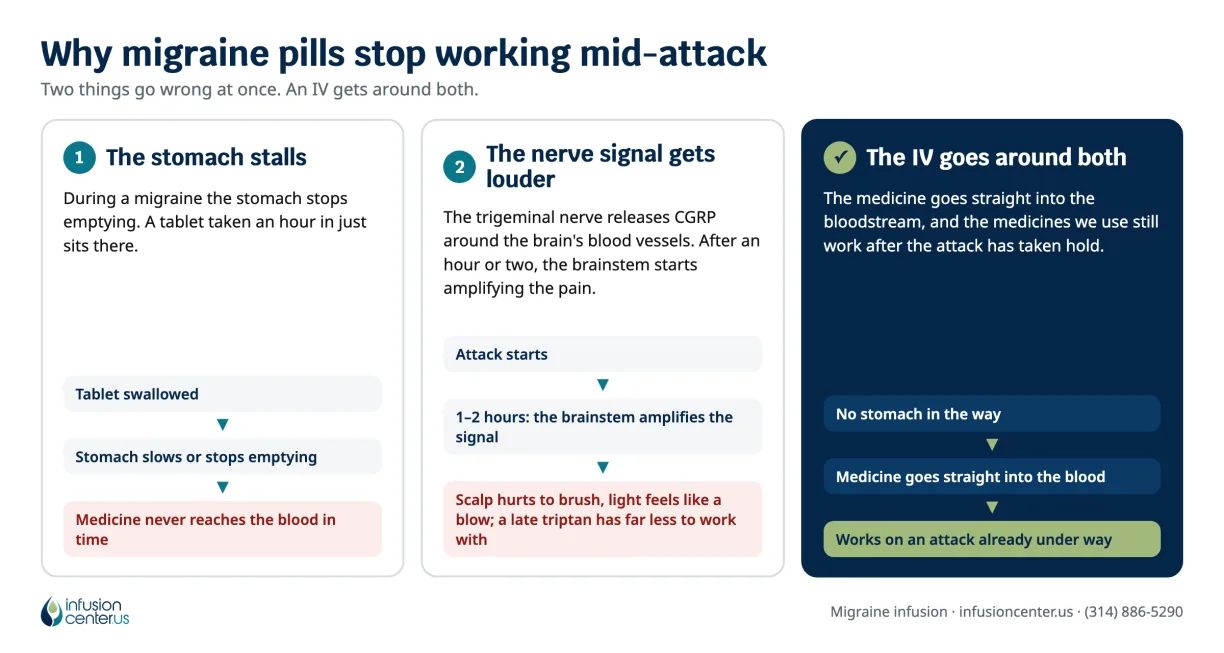
Two things go wrong at once. First, the stomach stalls during a migraine. A tablet swallowed an hour in sits in a stomach that has stopped emptying, so it never reaches the blood in time. Second, the attack changes the nervous system as it runs. The trigeminal nerve releases CGRP onto the blood vessels around the brain, and after an hour or two the brainstem starts amplifying the signal. Once that happens, your scalp hurts to brush and light feels like a blow, and a late triptan has far less to work with.
An IV gets around both problems. The medicine goes straight into the bloodstream, and the medicines we use still work after the attack has taken hold.
What happens at a migraine infusion visit?
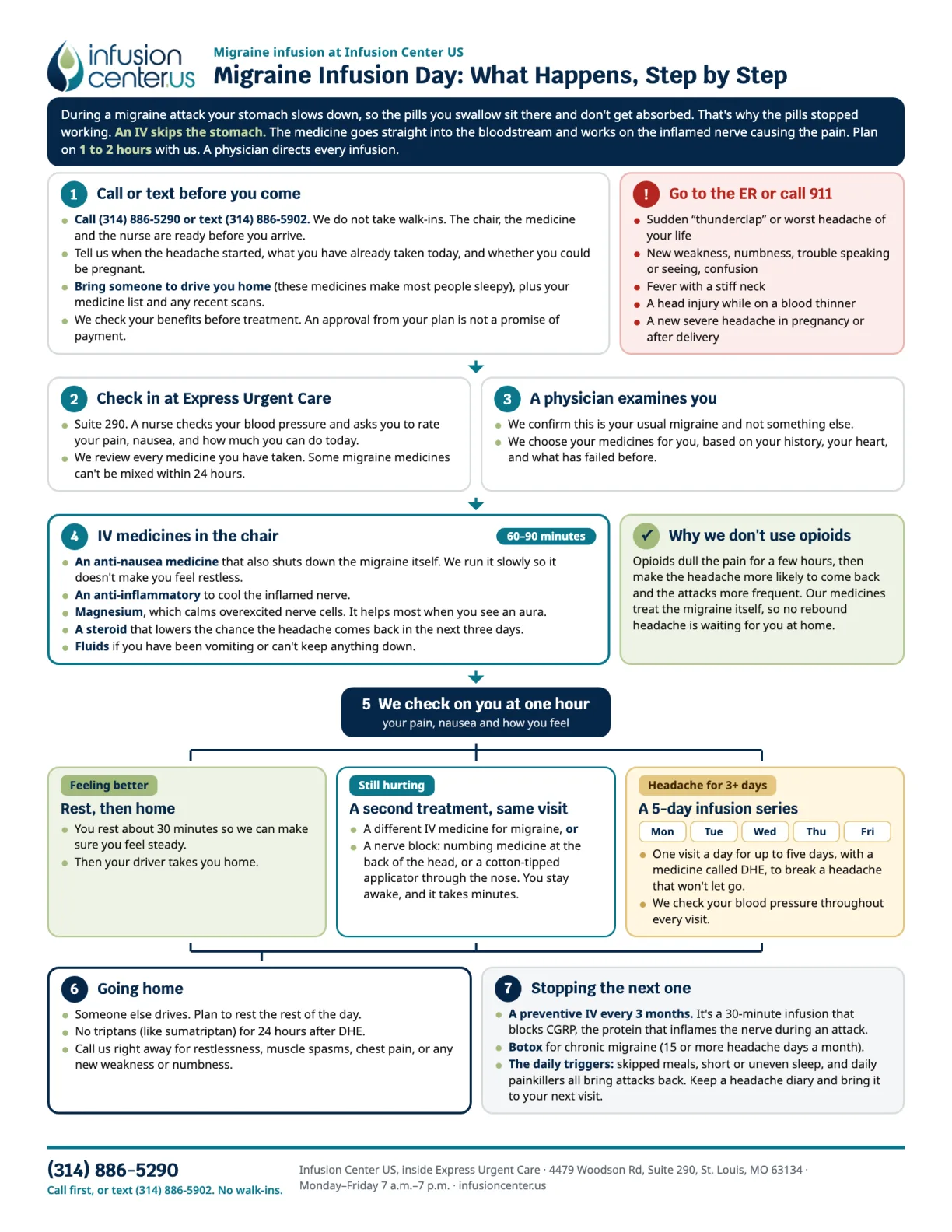
- Call or text first. We do not take walk-ins for infusions. Tell us when the headache started, what you have taken today, and whether you could be pregnant.
- Check in at Express Urgent Care. A nurse takes your blood pressure and asks you to rate your pain, your nausea and how much you can do today.
- A physician examines you. We confirm this is your usual migraine and choose the medicines around your history, your heart and what has already failed.
- The IV runs for 60 to 90 minutes while you rest in a recliner with the lights down.
- We check on you at one hour. If you are better, you rest about 30 more minutes and go home. If you are not, you get a second treatment in the same visit.
- Someone drives you home. These medicines make most people sleepy.
What goes into the IV?
- An anti-nausea medicine that also shuts down the migraine. We run it slowly, which keeps it from making you feel restless.
- An anti-inflammatory for the inflamed nerve endings.
- Magnesium, which quiets overexcited nerve cells and helps most when you get an aura.
- A steroid that lowers the chance the headache comes back over the next three days.
- Fluids when you have been vomiting or cannot keep anything down.
No opioids. They dull the pain for a few hours and then make the next attack likelier, the same rebound cycle that daily painkillers set up.
What if the first round does not work?
The second treatment is a different IV medicine for migraine, or a nerve block: numbing medicine at the back of the head, or a cotton-tipped applicator placed through the nose. You stay awake for it and it takes minutes. A headache that has gone three days or more gets a different plan: one DHE infusion a day, Monday through Friday, to break the cycle, with your blood pressure watched throughout every visit.
Stopping the next attack
Relief today is half the job. If you are having migraines several days a month, the same chair gives a preventive infusion every 12 weeks. It is a 30-minute IV that blocks CGRP, the protein the nerve releases during an attack. Botox is the other option for chronic migraine. Daily habits matter just as much. Skipped meals, short or uneven sleep and painkillers taken most days all bring attacks back. Keep a headache diary and bring it to the follow-up visit.
Go to the ER or call 911 instead for a sudden “thunderclap” headache or the worst of your life, new weakness, numbness, trouble speaking or seeing, fever with a stiff neck, a head injury while on a blood thinner, or a new severe headache in pregnancy or after delivery.
Coverage is checked before your first infusion. Many infusions, biologics in particular, need prior authorization from your plan. An approval is not a promise of payment; your plan still decides each claim.
Questions patients ask
How long does a migraine infusion take?
Plan on one to two hours from check-in to discharge. The IV itself runs 60 to 90 minutes. Details are on what to expect at your IV infusion.
Can I drive home after a migraine infusion?
No. The anti-nausea medicine and the antihistamine given with it make most people drowsy, so bring a driver. More on aftercare.
Is a migraine infusion the same as a migraine cocktail?
“Migraine cocktail” is the emergency-room name for the same idea: several IV medicines given together. Here it is given without the ER wait and without opioids. Call or text us to set a time.
How long does relief from a migraine infusion last?
The goal is to end the attack before you leave, and the steroid in the IV lowers the chance it comes back over the next three days. If attacks keep returning every week or two, the next step is prevention, which the same chair gives every 12 weeks. Call us to talk it through.
What are the side effects of a migraine infusion?
Sleepiness is the most common, which is why you need a driver. The anti-nausea medicine can cause an inner restlessness, so we run it slowly and give an antihistamine with it. The steroid can push blood sugar up for a day, so tell us if you have diabetes. Aftercare is on what to expect at your IV infusion.
Do I need a referral for a migraine infusion?
No. You can call us yourself. If your neurologist or primary doctor wants to send you, they can refer a patient here.